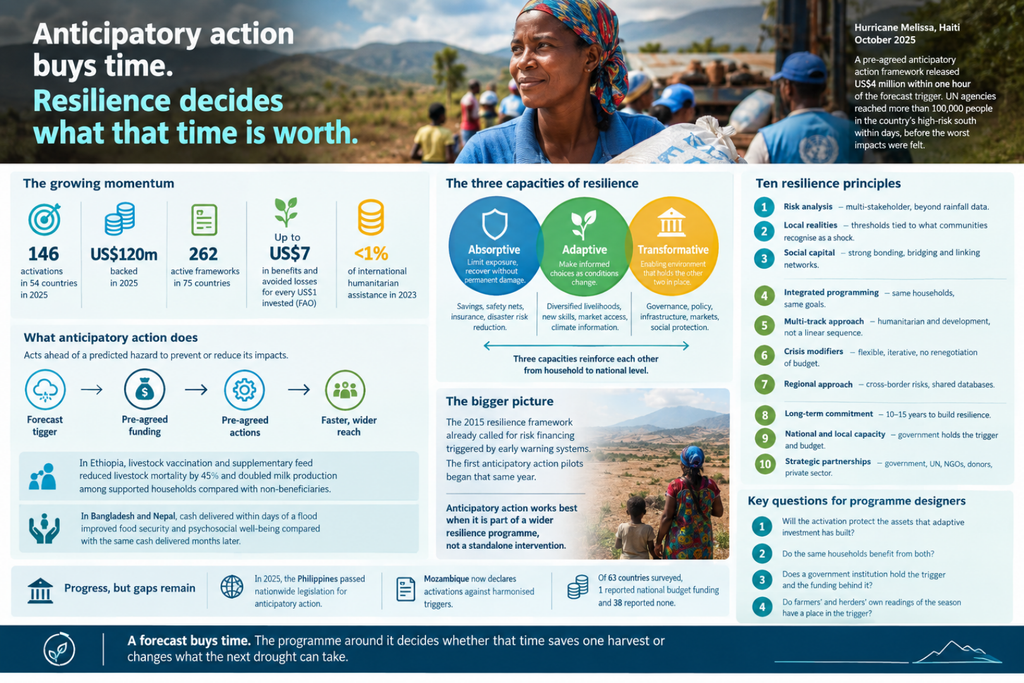
When Hurricane Melissa approached Haiti in October 2025, a pre-agreed anticipatory action framework released US$4 million within one hour of the forecast trigger. UN agencies reached more than 100,000 people in the country’s high-risk south within days, before the worst impacts were felt. That is the promise of anticipatory action. The harder question for anyone designing climate resilience programmes is what that speed should buy, and for whom.
Anticipatory action means acting ahead of a predicted hazard to prevent or reduce its impacts. It works best when triggers, actions and funding are agreed before the forecast arrives. This approach is expanding quickly. In 2025 there were 146 activations in 54 countries, backed by almost US$120 million, alongside 262 active frameworks in 75 countries. The Food and Agriculture Organization (FAO) estimates that households gain up to US$7 in benefits and avoided losses for every US$1 invested. Yet, budgets for anticipatory action frameworks accounted for less than 1% of international humanitarian assistance in 2023.
The logic is older than the label. Rereading a 2015 resilience strategic framework recently, I was struck by how much of it was already there. The framework called for risk financing triggered by early warning systems. Transfers would be released once indicator thresholds were crossed, so that households did not sell productive assets to survive a shock. It also asked for trigger thresholds to be agreed in advance, with sensitivity to the politics of decision-making. It was drafted in the same year that the first anticipatory action pilots began.
Like much resilience thinking from that period, the framework organises resilience around three capacities. It draws on work by Béné and colleagues at the Institute of Development Studies and Frankenberger and colleagues at the International Food Policy Research Institute. Absorptive capacity is the ability to limit exposure to shocks and recover without permanent damage to livelihoods, using savings, informal safety nets, hazard insurance and disaster risk reduction. Adaptive capacity is the ability to make informed choices about alternative livelihoods as conditions change. Transformative capacity is the enabling environment of governance, policy, infrastructure, markets and social protection that holds the other two in place. The three reinforce each other from household to national level.
One line in the framework’s annex repays a second reading. Diversifying into drought-tolerant crops spreads a household across crops, not across risks, because every crop still depends on rain. Adaptive capacity grows when livelihoods carry different risk profiles.
Anticipatory action sits squarely in the absorptive column. That is its strength and its limit. Ahead of drought in Ethiopia in early 2025, livestock vaccination and supplementary feed reduced livestock mortality by 45% and doubled milk production among supported households compared with non-beneficiaries. A randomised trial in Bangladesh and Nepal found that cash delivered within days of a flood improved food security and psychosocial well-being compared with the same cash delivered months later. The Anticipation Hub’s 2025 review summarises that trial as showing that earlier transfers prevent acute hardship sooner without producing fundamentally different livelihood outcomes. An anticipatory transfer protects a household’s herd this season. It does not change why the herd is the household’s main buffer. On its own, anticipatory action risks making the humanitarian cycle less costly rather than shorter.
This is where the framework’s ten resilience principles earn their place. They were adapted from UNDP, Mercy Corps, DFID, USAID and EU approaches. Read as a design checklist, they turn anticipatory action from better-timed relief into one component of a resilience system.
Three principles govern how risk is understood:
1. A comprehensive, multi-stakeholder risk analysis grounds triggers in more than rainfall data.
2. Anchoring programmes in national and local actors’ realities keeps thresholds tied to what communities recognise as a shock.
3. Strengthening bonding, bridging and linking social capital determines whether a warning travels from a district office to a village savings group in time for anyone to act.
Four principles shape programme design:
1. Same household the programme is helping to diversify.
2. A multi-track approach layers humanitarian and development tracks so they complement each other, replacing the linear sequence from relief to recovery to development.
3. Crisis modifiers, built into an iterative and flexible process, enable a development programme to switch to early response when a trigger is met without renegotiating its budget.
4. The regional approach recognises that droughts and cyclones cross borders. Partners are now building a shared trigger-threshold database for eastern Africa.
Three principles sustain the effort:
1. Long-term commitment matters because the framework expects resilience to take 10–15 years to build, considerably longer than most project cycles. Building national and local capacity keeps the trigger, and the budget line behind it, in government hands.
2. Strategic partnerships across government, UN agencies, NGOs, donors and the private sector share both the risk analysis and the cost.
3. Governments are beginning to act on the capacity principle. In 2025 the Philippines became the first country to pass nationwide legislation for anticipatory action. In Mozambique, the national disaster management institute now declares activations against harmonised triggers, so partners act on one decision rather than several. The budget line lags behind. Of 63 countries surveyed in 2025, one reported national budget funding for anticipatory action and 38 reported none.
The lesson for programme designers is structural. Anticipatory action frameworks should sit inside resilience programmes, not beside them. Before signing off a trigger, I would ask three questions. Will the activation protect the assets that adaptive investment has built? Do the same households benefit from both? Does a government institution hold the trigger and the funding behind it? My doctoral research compared women’s and men’s perceptions of a changing climate with more than 80 years of instrumental records, so I would add a fourth. Do farmers’ and herders’ own readings of the season have a place in the trigger?
A forecast buys time. The programme around it decides whether that time saves one harvest or changes what the next drought can take.