
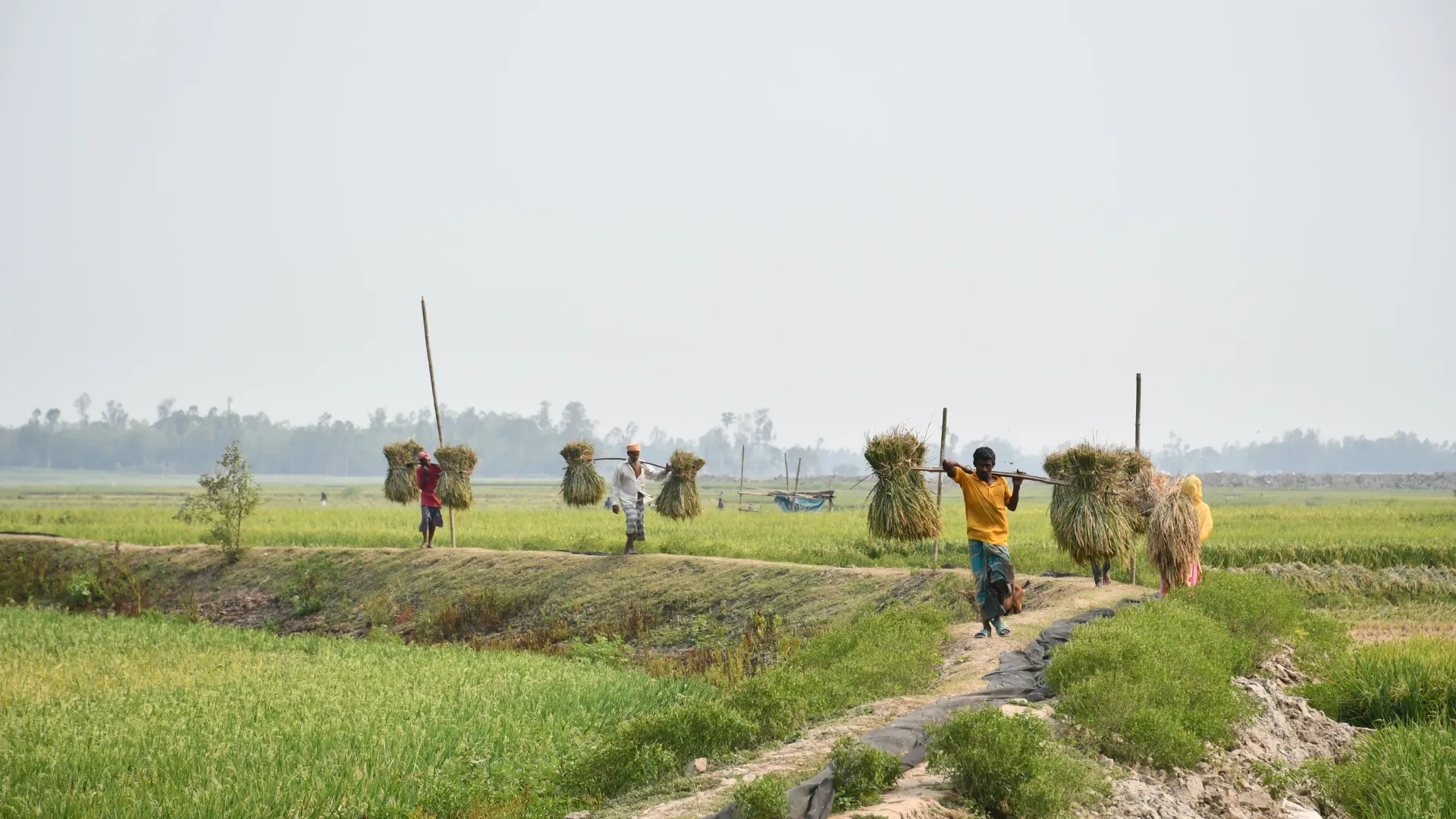
The technical options for managing drought, coastal erosion and extreme heat are documented, and across many of the 117+ countries where C4 EcoSolutions has worked they have already been piloted.
‘What slows the implementation these interventions is the time funding takes to travel from accreditation to disbursement. In addition, local evidence of effectiveness is seldom used to its full potential in justifying the selection of an intervention.’
Johan Rockström reached a parallel conclusion for mitigation at the Greentopia initiative during Way Out West in Gothenburg, Sweden. The constraint, he argued, is no longer an absence of solutions, but whether governments are politically capable of implementing them. Three of his points travel directly into adaptation practice.
The first point concerns the buffer. Oceans, forests and soils absorb approximately half of the carbon dioxide released from fossil fuels, and that absorption is partly what has held observed warming below what emissions would have otherwise resulted in. Rockström’s concern is that this mechanism is weakening. For adaptation planners the implication is awkward, because adaptation needs are commonly assessed against climate scenarios that may not fully capture the consequences of a faster-than-expected weakening of natural carbon sinks
The second point concerns the economy. Treating ecological decline as separate from economic performance is a category error. Low water on the Rhine and the Danube is a logistics problem before it is an environmental one, and a failed maize harvest in southern Africa is a fiscal problem before it is an agronomic one. Finance ministries, rather than environment ministries, are where the adaptation argument should now be made.
The third point concerns leadership from countries whose emissions are small. Rockström makes the case that Sweden, sharing an atmosphere with 194 others, gains rather than loses by moving first. In many of the countries where C4 EcoSolutions works, however, low emissions create a very different circumstance: they have contributed little to climate change but are already being forced to respond to some of its most severe consequences. Several are producing adaptation planning of remarkable rigour, yet the imbalance between carbon footprints and climate responsibilities in these countries often does not reach the leaders and decision makers who influence global climate finance.
He ended on a line worth keeping in mind. “Failure is a choice, not an inevitability.” For mitigation, that reads as a call to political courage and will to act to reduce atmospheric carbon. For adaptation, it reads as a question about the pace at which finance reaches the institutions that would spend it, and about who is answerable when that pace slips.