
When connectivity becomes vulnerability
The Late Bronze Age eastern Mediterranean — spanning roughly 1400 to 1200 BCE — formed one of the ancient world’s most sophisticated interconnected systems. Greece, Anatolia, Egypt, Cyprus, the Levant and Mesopotamia were bound together by trade routes, diplomatic relationships and cultural exchange that moved goods, people and knowledge across vast distances. But, to call this connectivity merely commercial would not do justice to its depth. What flowed along those routes was the biological and material foundation of civilisation itself.
Consider bronze, the defining technology of the age. Producing it required copper, sourced primarily from Cyprus and the Levant, and tin. Although the origin of the latter remains debated, isotopic analyses increasingly point to Cornwall in southwest Britain and deposits in Central Asia. These metals travelled thousands of kilometres by maritime and overland trade. The workshops that processed them depended on workers who needed to eat. In turn, this required reliable grain supplies, much of which was grown in Egypt and redistributed through palace economies across the region. Those harvests, in turn, depended on functioning ecosystems: on rivers that flooded predictably and recharged groundwater, on soils sustained by organic matter and microbial activity, on the biological productivity that agriculture ultimately transforms into food. Cedar from the Levantine coast fuelled smelting furnaces and supplied ship-timber; Aegean olive oil and wine circulated as goods and diplomatic currency. None of these material and ecological relationships existed independently — each sustained, and was sustained by, the others.
This entanglement generated extraordinary prosperity — and extraordinary vulnerability. Urban centres expanded by drawing on resources from across the region. Populations grew in places that could not sustain themselves from local harvests alone. As specialisation deepened, so did dependency: on trade routes beyond any single state’s control, on political relationships that required continuous maintenance, and on the productive landscapes and functioning ecosystems that underpinned all of it. A drought that reduced grain surpluses, a political rupture that closed a trade route, a gradual degradation of soils and watersheds — any of these could send consequences cascading far beyond their point of origin, through a system with increasingly few buffers to absorb them.
When those systems began to unravel in the decades around 1200 BCE, the effects were rapid and profound: cities abandoned, trade networks fractured, several major kingdoms erased from the historical record. The centuries that followed — marked by population decline, reduced long-distance exchange and the loss of literacy in some regions — are what historians refer to as the Greek Dark Age. Modern economies are structured around a comparably dense web of dependencies — global food systems that move grain across continents, energy networks that span hemispheres, supply chains for critical materials in which a single disruption can propagate across dozens of economies. The question this history forces us to consider is not merely archaeological: how do highly integrated systems maintain resilience when multiple compounding pressures emerge simultaneously?
The ecological roots of collapse
What makes the Bronze Age Collapse so remarkable is not only its scale but its speed. Within a few decades, cities across the eastern Mediterranean were destroyed or abandoned, palace economies collapsed and political structures that had persisted for centuries disappeared. Growing consensus points not to a single catastrophic cause but to multiple pressures interacting within systems already losing their capacity to adapt. This erosion began not in the palaces or on the trade routes, but in the soils and watersheds that sustained everything above them.
Evidence from multiple independent climate archives — pollen records, lake sediments, cave speleothems and stable isotope analyses — indicates a shift towards drier conditions across parts of the eastern Mediterranean during the late second millennium BCE. Reduced and less reliable rainfall would have placed progressive strain on agricultural systems operating at the margins of regional food security. Soils under sustained drought lose organic matter and microbial activity; degraded soils store and transmit water less effectively; reduced vegetative cover accelerates erosion and further diminishes fertility. The effects compound quietly, season by season, before manifesting in harvests. Contemporary written records suggest the consequences were already being felt: diplomatic correspondence from Hittite, Ugaritic and Egyptian sources describing food shortages, urgent appeals for grain shipments and mounting anxiety over agricultural output. One letter, attributed to the Hittite queen Puduhepa writing to the Egyptian pharaoh Ramesses II in the years before the collapse, is stark in its simplicity: ‘I have no grain in my land.’
Dendrochronological records add a further dimension. Tree-ring chronologies from subfossil Irish bog oaks (Quercus robur) and North American bristlecone pines (Pinus longaeva) — species whose annual ring widths are sensitive proxies for temperature and moisture — show a sustained period of narrower rings consistent with cooler and/or drier growing conditions around 1250–1100 BCE. Whether large volcanic eruptions, including the Hekla 3 event in Iceland — imprecisely dated, with estimates ranging from c. 1159 to 929 BCE — contributed additional cooling through stratospheric aerosol forcing remains contested, but the broader climatic signal across independent archives is consistent.
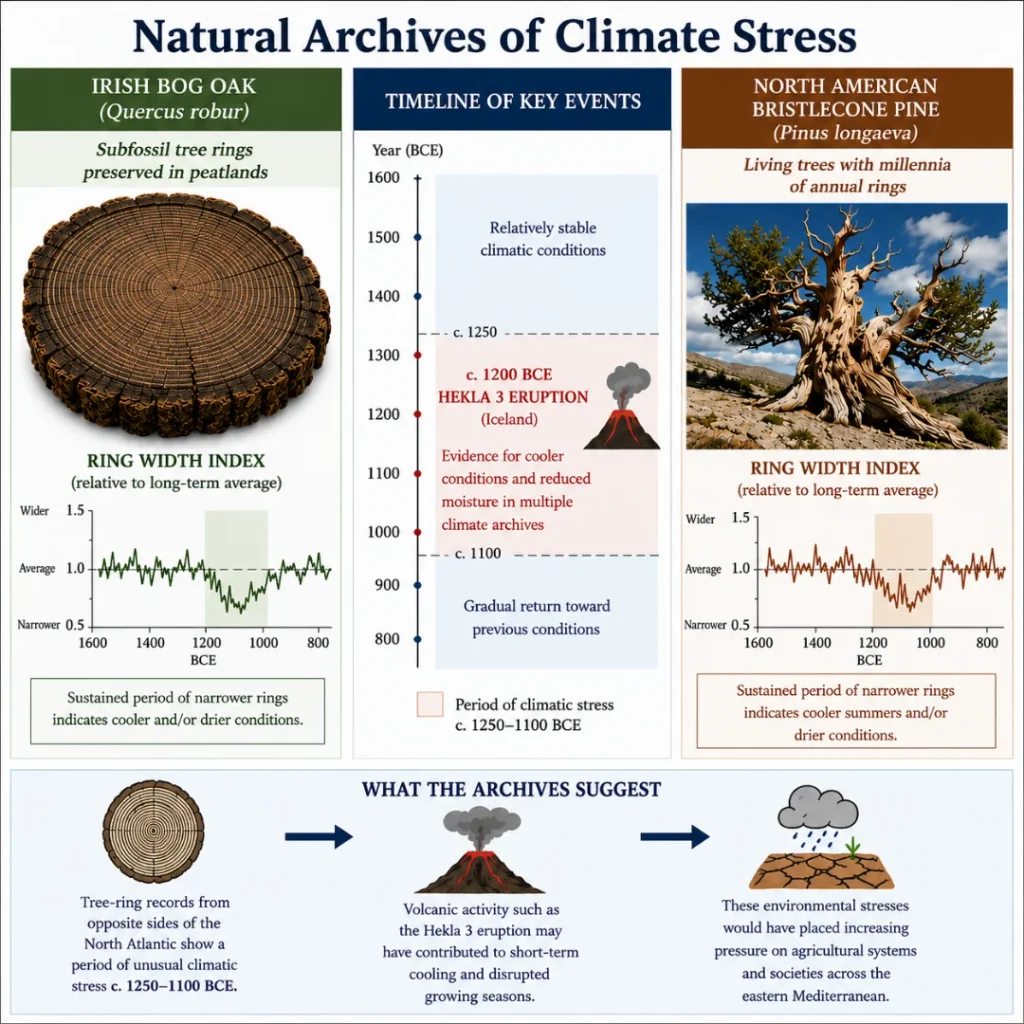
Climate alone cannot explain what happened across a region as geographically and culturally diverse as the eastern Mediterranean, and the evidence does not support environmental determinism. What it does suggest is that ecological and agricultural systems across parts of the region were under increasing stress before the political consequences became visible. Reduced agricultural output contracted the surpluses that sustained trade; trade disruption cut off food imports on which urban populations had come to depend; political instability further undermined the diplomatic channels through which resources were redistributed — each failure amplifying the next. The underlying sequence — ecological stress quietly eroding agricultural and economic foundations before the political consequences become apparent — is among the most consequential and least visible dynamics in human history, and it did not end with the Bronze Age.
People move before empires fall
When societies come under sustained pressure, political collapse is rarely the first consequence to appear. Long before kingdoms fragment, people adapt — changing how they farm, how they trade, how they organise their communities. When conditions deteriorate sufficiently, migration becomes part of that adaptation. The centuries surrounding the Bronze Age Collapse may offer one of the earliest well-documented examples of this pattern.
Among the most debated actors of this period are the Sea Peoples — a modern scholarly term for a loose grouping of peoples recorded in Egyptian sources during the final decades of the Late Bronze Age. Their constituent groups bore names such as the Peleset, Tjekker, Denyen, Sherden, Shekelesh and Weshesh, and their geographic origins remain uncertain, with proposed identifications spanning the Aegean, western Anatolia, Cyprus, Sardinia, Sicily and the Levantine coast. For much of the twentieth century, they were portrayed as hostile invaders of obscure origin whose sudden arrival helped bring down established civilisations. That narrative has become increasingly difficult to sustain.
Reliefs and inscriptions from the mortuary temple of Ramesses III at Medinet Habu (c. 1180 BCE) record a multi-front confrontation between Egyptian forces and these groups by land and sea. But the imagery is more complex than military raiding. Alongside armed fighters are families, livestock and ox-carts loaded with possessions — the signature of communities in motion rather than armies on campaign. Some scholars have interpreted this as evidence that at least portions of the Sea Peoples were displaced populations moving not out of aggression but out of necessity, their homelands already undone by conflict, ecological deterioration or economic collapse. The evidence does not resolve whether these were peoples fleeing ecological and economic collapse or opportunistic raiders exploiting a weakening empire — but the pattern it raises is one that recurs throughout human history.
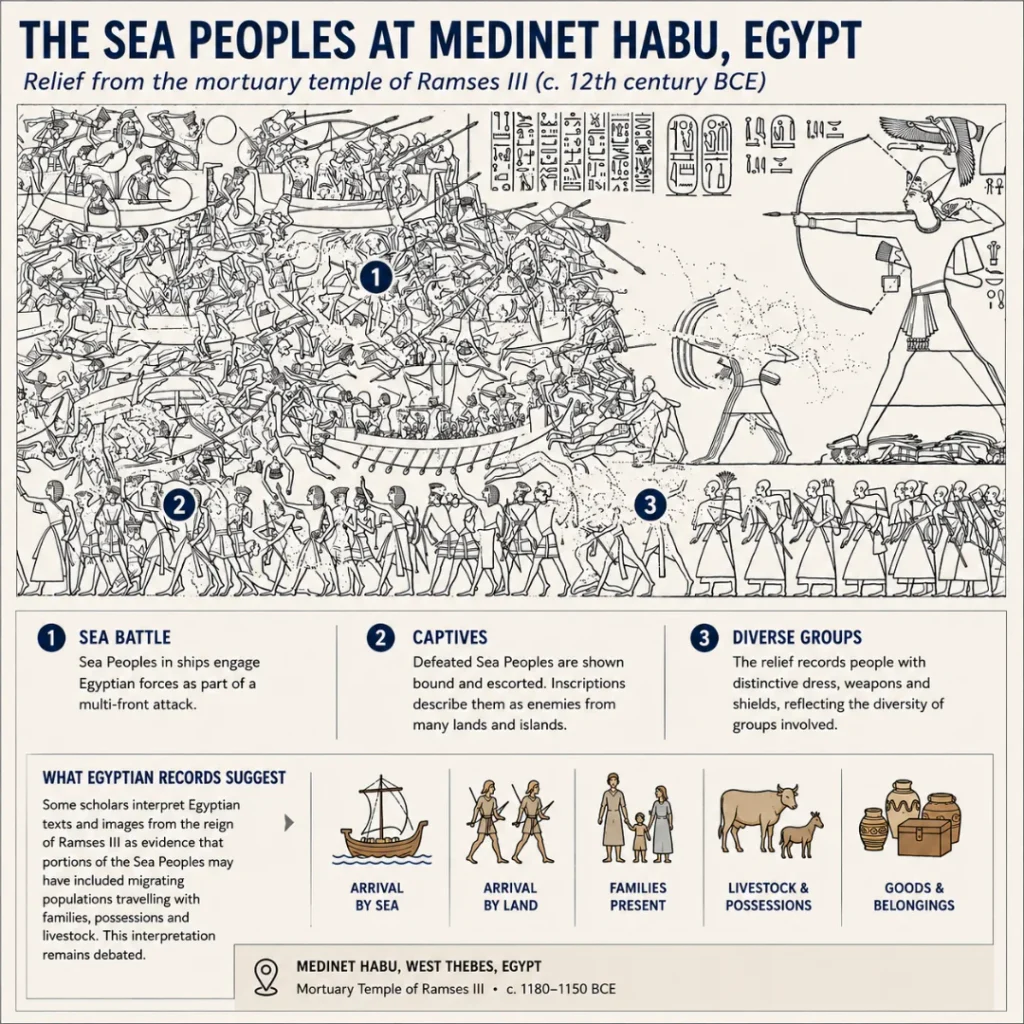
Seen in this light, the Medinet Habu reliefs pose a more troubling question that is less military than social: who exactly were these people, and what had set them in motion? To those whose lands they entered, they would have appeared as invaders — a source of violence, instability and competition for resources. But if their movement reflected a response to deteriorating conditions elsewhere, the boundary between aggressor and refugee becomes considerably less clear. Migration, in this reading, is not simply an event but a signal: one of the earliest visible indicators that the systems sustaining livelihoods somewhere else have begun to fail.
Four centuries ago, a speech in Sir Thomas More — often attributed to Shakespeare — urged Londoners to consider not only the threat posed by foreign arrivals but what might have driven people to leave their homes in the first place. The question is sharper today. Research on the Syrian drought of 2006–2010 — one of the most severe in the region’s recorded history — has documented how agricultural collapse and rural displacement contributed to the social conditions preceding the 2011 conflict and the migration crisis that followed. Climate change is rarely the sole cause of such movements, but it is increasingly the pressure that interacts with and amplifies the others. And its consequences arrive first not in headlines but in soil moisture deficits, declining groundwater tables and falling agricultural yields — signals that rarely cross political borders as visibly as people do.
Treating migration primarily as a challenge of border management rather than a symptom of failing livelihoods elsewhere is, in this sense, a category error. Durable responses require attention to the source: to the agricultural, ecological and economic conditions in the regions people are leaving, and to the pressures that make staying increasingly untenable.
Building resilience before the crisis
More than three thousand years after the Bronze Age Collapse, its precise causes remain contested, though its broader lesson is perhaps clearer than the specifics.
The evidence does not point towards inevitable decline. Many communities navigated the period of disruption successfully, adapting their livelihoods, adjusting trade relationships and reorganising their settlement patterns in ways that left fewer dramatic traces in the archaeological record than the abandonment of cities or the disappearance of royal dynasties. What distinguished those that adapted from those that collapsed is not fully resolved, but the pattern suggests that diversity and redundancy — in food sources, trade relationships and ecological buffers — preserved more options when conditions changed.
Resilience, understood in this way, is not primarily about reducing exposure to risk. It is about maintaining the capacity to respond when risk materialises. Healthy ecosystems support that capacity directly: through water regulation, soil fertility and the biological productivity that agricultural systems depend upon. When those foundations are intact, agricultural systems can absorb variability. When they degrade — through overexploitation, sustained drought or ecosystem degradation — their buffering capacity declines, and shocks that might once have remained local cascade into every system connected to them.
This dynamic is not ancient history. Across the Sahel, decades of ecosystem degradation, rainfall variability and population pressure have eroded the agricultural foundations that rural communities depend upon, driving displacement patterns that now reach well beyond the region’s borders. In the Horn of Africa, recurrent drought has interacted with conflict and failing food systems to produce one of the world’s most severe ongoing humanitarian crises. Along the Indus and the Nile, overextraction of groundwater and declining soil productivity are quietly narrowing the agricultural margins on which hundreds of millions of people depend — pressures that accumulate below the threshold of political visibility until, as the Bronze Age illustrates, they no longer can.
Closer to home, a similar and intensifying dynamic is playing out. Prolonged drought and recurrent maize crop failures in Zimbabwe, cyclone damage to agricultural land in Mozambique and Malawi, and accelerating topsoil loss and groundwater depletion across the subcontinent have driven sustained displacement towards South Africa’s borders — where it is being met, as it has been throughout history, with the language of invasion rather than the question of what set people in motion in the first place.
The foundations of resilience are built in ordinary times — in the health of soils and watersheds, the diversity of livelihoods, the robustness of the ecological systems that underpin food production — long before any crisis makes their importance apparent. By the time cities are abandoned or borders close, the decisions that shaped the outcome were made decades earlier. Climate change does not create this vulnerability, but it progressively erodes the ecological buffers that might otherwise absorb it, compressing the margins within which adaptation remains possible. Investing in ecosystem restoration, sustainable land management and agricultural resilience in vulnerable regions is not a peripheral supplement to climate adaptation strategy — it is the mechanism by which those foundations are maintained before the signals of failure become impossible to ignore.
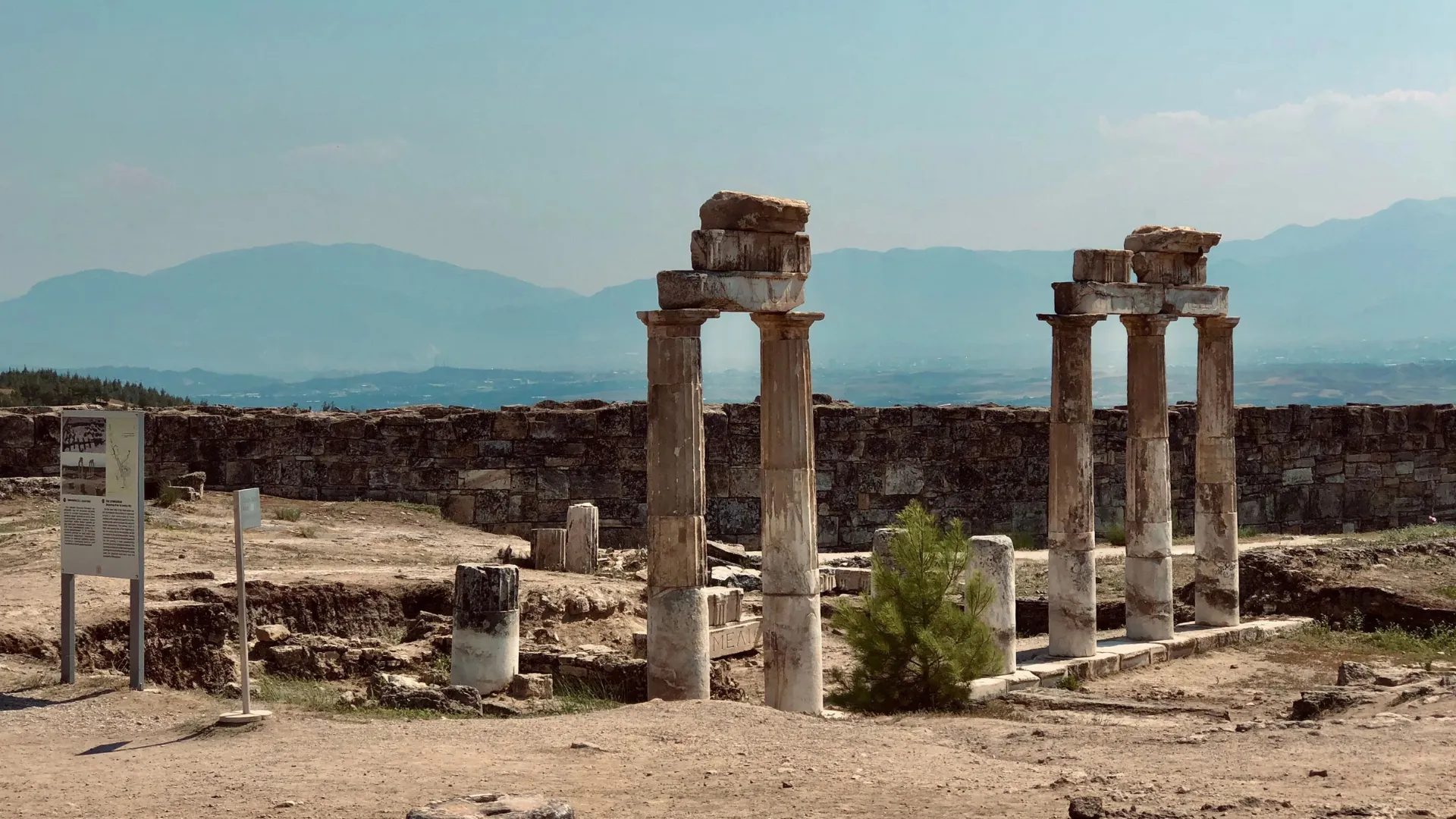
The Hittite queen who wrote ‘I have no grain in my land’ was not recording the beginning of a crisis — by the time those words were inscribed, the soils had been failing for years, and the trade routes were already under strain. Her letter was not a warning but a consequence, arriving after the decisions that might have changed the outcome had already been made, or left unmade, in the ordinary seasons before. The ruins scattered across the eastern Mediterranean still bear the imprint of what followed: degraded soils, deforested hillsides, silted river channels that once sustained intensive agriculture. The landscape remembers what the historical record only partially preserves.
What the Bronze Age offers, three thousand years on, is not a cautionary tale in the simple sense but something more demanding — a demonstration of how quickly the foundations of complex, prosperous systems can erode when placed under pressures they are not structured to absorb. Climate change is accumulating those pressures now, and the signals are not quiet. The question it leaves for the present is not whether those pressures are building — the evidence on that point is not in dispute — but whether the decisions being made today, in ordinary times, are adequate to what the decades ahead will require.