
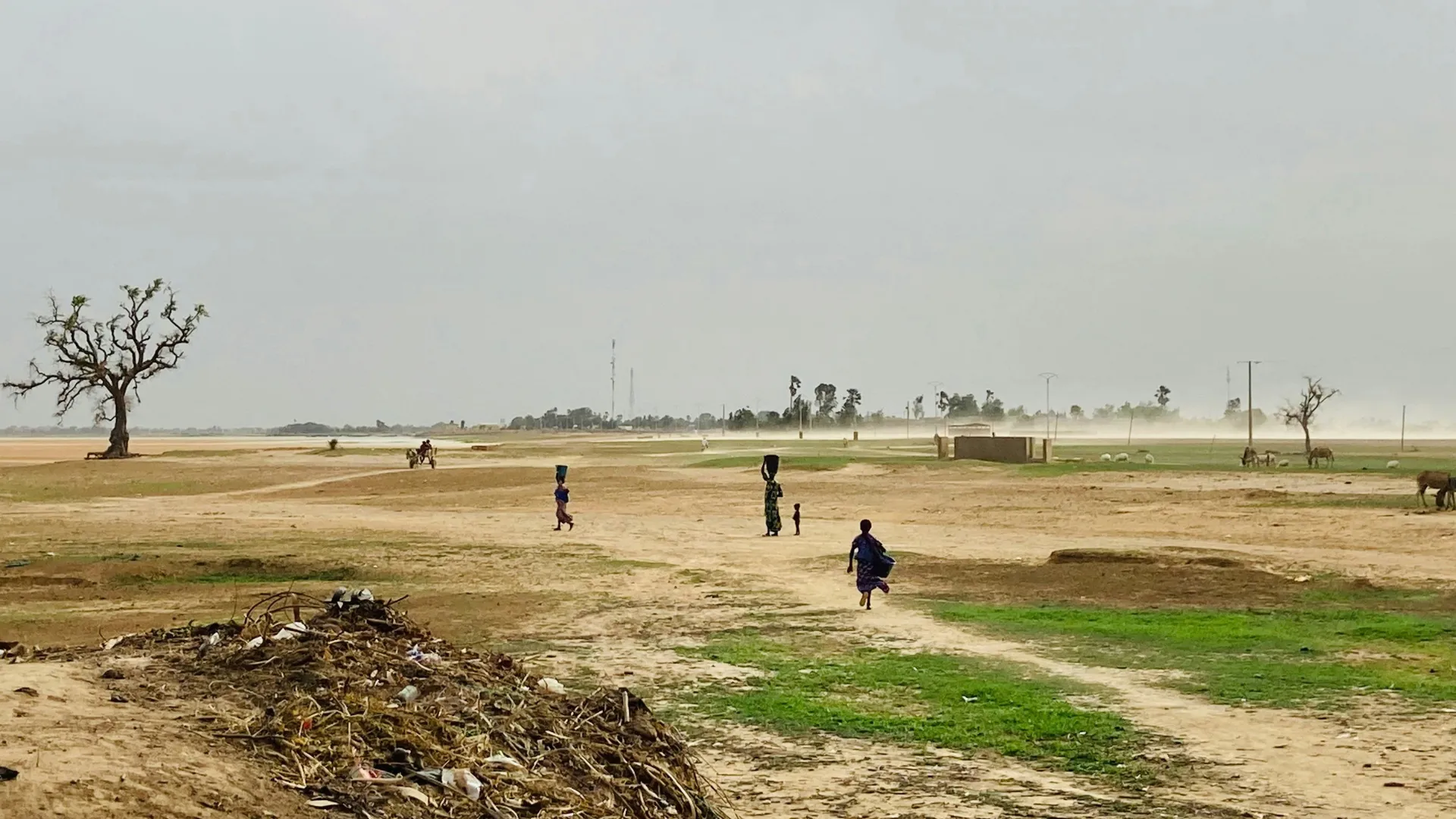
Despite gaining more attention in policy circles, the connections between climate change, governance and security are rarely treated as a single, connected problem in practice.
C4 draws on specialists with backgrounds in this exact kind of work. Jaun, a Carbon Development Director at C4, spent five years in Mali leading the science and delivery behind a climate resilience programme before joining the firm. His experience which now informs much of the work that Juan and his team carry out at C4.
Climate: A Changing Pattern
Mali is characterised by arid, desert-edge terrain towards the north of Mopti town. South of Mopti lies more fertile savanna, where most of the country’s farming takes place. Over recent decades, rains have shifted across Mali and the wider Sahel. The desert has shifted southwards, with catchments receiving less rain, negatively impacting habitats that support wildlife. For a country heavily dependent on hydropower and rain-fed, subsistence agriculture, these changes in rainfall patterns compromise energy availability, food security and household livelihoods. Over time, the strain on energy systems and the broader economy can deepen existing instability across the wider Sahel.
The climate resilience programme therefore began with a problem analysis. This entailed assessing weather patterns and how they affected agricultural yields, catchment conditions and habitat quality. Satellite imagery, weather radar and meteorological data helped the team to forecast conditions and monitor how vegetation and agricultural production changed over time.
The proposed solution was cloud seeding — a weather-modification technique that uses aircraft to introduce salt flares into suitable storm systems, with the aim of increasing rainfall within Mali’s catchments. In addition, ground teams monitored rainfall and supported farmer training, including on how to make better use of available water resources and adjust planting practices. As such, technical solutions were accompanied by building local communities’ capacity to apply the programme’s solutions effectively.
Governance: An Essential to Shared Ownership
For effective delivery, the programme required close coordination with Malian institutions. The national weather service, forestry and agriculture authorities, energy sector, local communities and the Ministry of Defence all had a direct stake in the programme. Representatives of Mali’s national weather service joined cloud-seeding flights as active participants in missions.
Shared ownership not only enables effective delivery; it also helps to ensure that climate projects remain viable and sustainable beyond the period of external implementation. In Mali, this meant recognising that agricultural authorities had an interest in improved yields; energy stakeholders in water reaching hydroelectric dams; forestry authorities in healthier habitats; and communities in more secure livelihoods. Understanding these different priorities — and designing the programme around them — was fundamental to delivery.
Security: A Daily Operating Reality
Security was equally integral to the programme. Some storm systems overlapped with areas affected by conflict north of Mopti. Before flights, the team coordinated with the Ministry of Defence to understand where it was safe to operate and to ensure that aircraft movements were known and authorised.
This was one of many practical considerations shaping operations. Planning fieldwork required an understanding of road conditions, local infrastructure and language, as well as relationships with people on the ground. Teams planned ahead, assessed routes and worked with local partners who understood the areas in which activities would take place. More broadly, strengthening food and energy security through improved water availability is a key aspect to addressing poverty and reducing the drivers of instability in the region.
The Big Picture
Beyond a successful flight and refined dataset, the programme’s ultimate measure of success was whether farmers could achieve better yields and livelihoods; whether more water reached dams that supplied electricity; and whether landscapes and habitats became more resilient.
As Jaun reflects from his experience in Mali, the priorities on the ground are ultimately straightforward: people want food on the table, safety for their families, and a decent future for their children.
With this in mind, C4’s approach to climate resilience remains holistic — strengthened by being part of TAG International, whose wider operational and strategic experience complements C4’s environmental and climate expertise. This is the approach C4 brings across all our work: understanding that a technical intervention can only work when it is designed around the realities of institutions and the communities they serve