
Effective community engagement is fundamental to the success of any carbon project. In this article, Keith Steunenberg, Senior Manager at C4 EcoSolutions, shares insights from his extensive experience designing and implementing community-centered carbon projects across diverse landscapes globally.
Drawing on years of fieldwork across Africa, the Middle East, and beyond, Keith explores the principles and practices that underpin successful community engagement—from initial sensitisation meetings and participatory mapping to long-term investments in local capacity building. His perspective reflects the reality that strong partnerships with communities sit at the heart of every credible carbon project.
Whether a project focuses on agroforestry, Sustainable Agricultural Land Management (SALM) practices or ecosystem restoration, most activities take place on land owned, used or managed by people. Their decisions shape carbon stocks, soil health, biodiversity and landscape resilience. For this reason, community engagement is not a checkbox, it is the foundation on which long-term project success is built.
At C4 EcoSolutions, we work across diverse landscapes globally, and although every project is different, one principle stays constant: solutions must be co-designed with the communities who steward the land. Our merger with TAG International strengthens this approach by combining C4’s environmental expertise with TAG’s extensive experience delivering large-scale programmes in challenging environments and managing sustained community engagement. This integrated capability ensures a deep understanding of how people farm, collect resources, cope with risk and make livelihood decisions, enabling interventions that are practical, credible and beneficial.
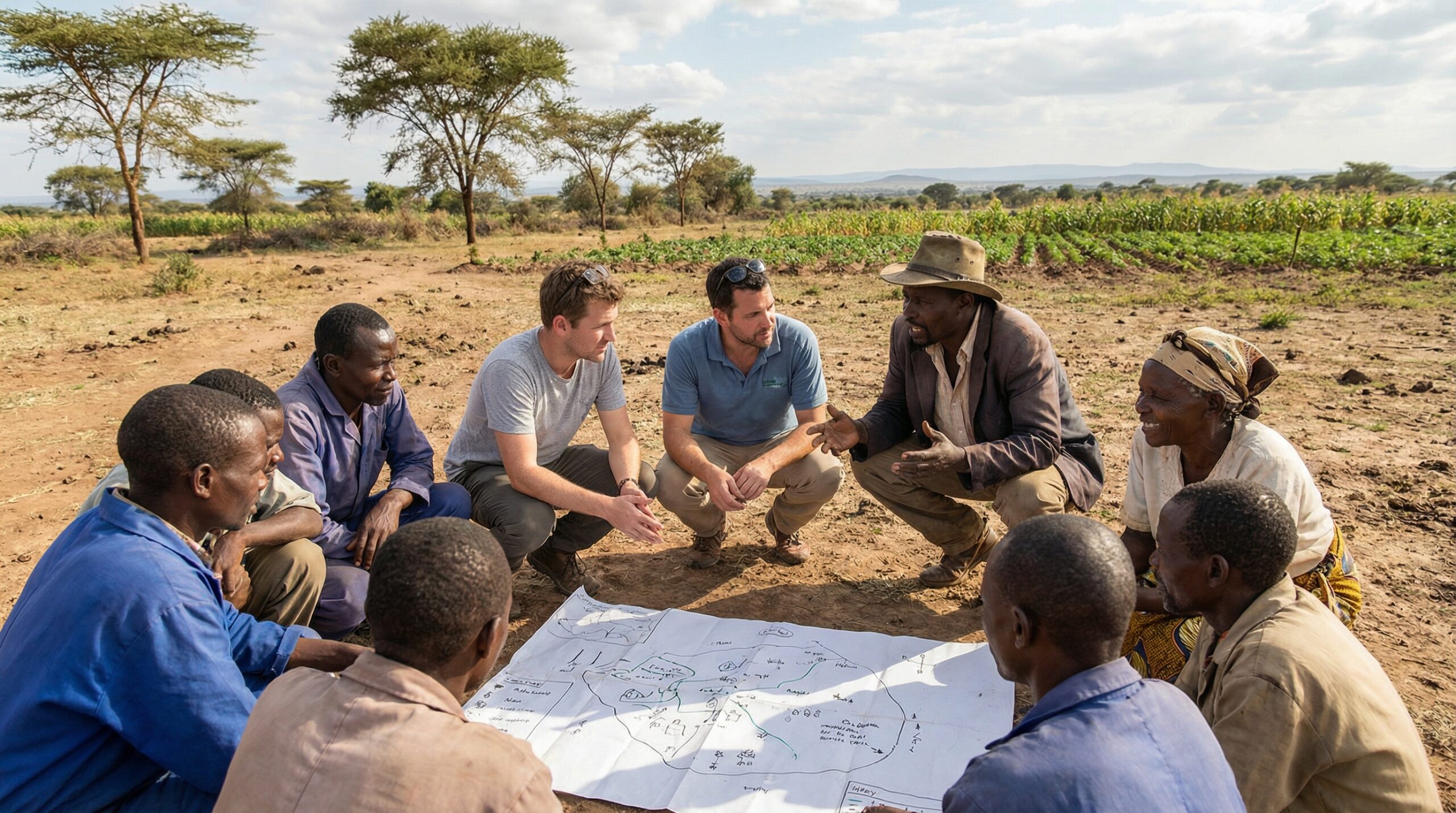
Early engagement starts with open, honest conversations. Project teams meet leaders, farmers and interest groups to discuss opportunities, potential challenges and the level of commitment expected. Sensitisation sessions explain what the project aims to achieve and what participation involves. These meetings often draw large groups and require time. But they help build trust, which only happens when people feel heard, respected and fully informed.
Communities shape the design of the project. They highlight land-use pressures, identify suitable areas for activities and describe the benefits that matter most, whether income generation, improved productivity, access to services or long-term security. Project teams then work with them to identify what is practical, affordable and aligned with carbon standard requirements. Benefits are structured over time and often linked to project performance, ensuring that communities see value throughout the project lifecycle.
Participatory mapping is a critical step. By walking the landscape together, teams and land users confirm where activities can occur, taking into account farming needs, cultural sites, tenure arrangements and resource use patterns. This gives communities direct control over where the project operates and strengthens ownership of the outcomes.
Engagement extends beyond individual villages. Environmental pressures rarely stop at a boundary and neither do the benefits. Projects work with local organisations, cooperatives and service providers to support wider livelihood development, improve market access, stimulate small businesses and create lasting economic value. The operational footprint of a carbon project — transport, employment, training, purchasing — often brings meaningful local economic activity to areas with few other opportunities.
C4’s approach recognises that many rural communities face demanding conditions, limited infrastructure and restricted livelihood choices. Engagement must therefore be realistic and long-term. Investments in training, education, skills development, local employment and improved services help communities adopt new practices and pass them on to the next generation. Over time, these improvements strengthen environmental stewardship and resilience.
High-integrity carbon projects depend on transparency, participation and shared decision-making. When community engagement is approached with respect and genuine collaboration, climate solutions become more durable, more inclusive and more effective. Getting this right is not just good practice — it is the reason carbon projects succeed.