
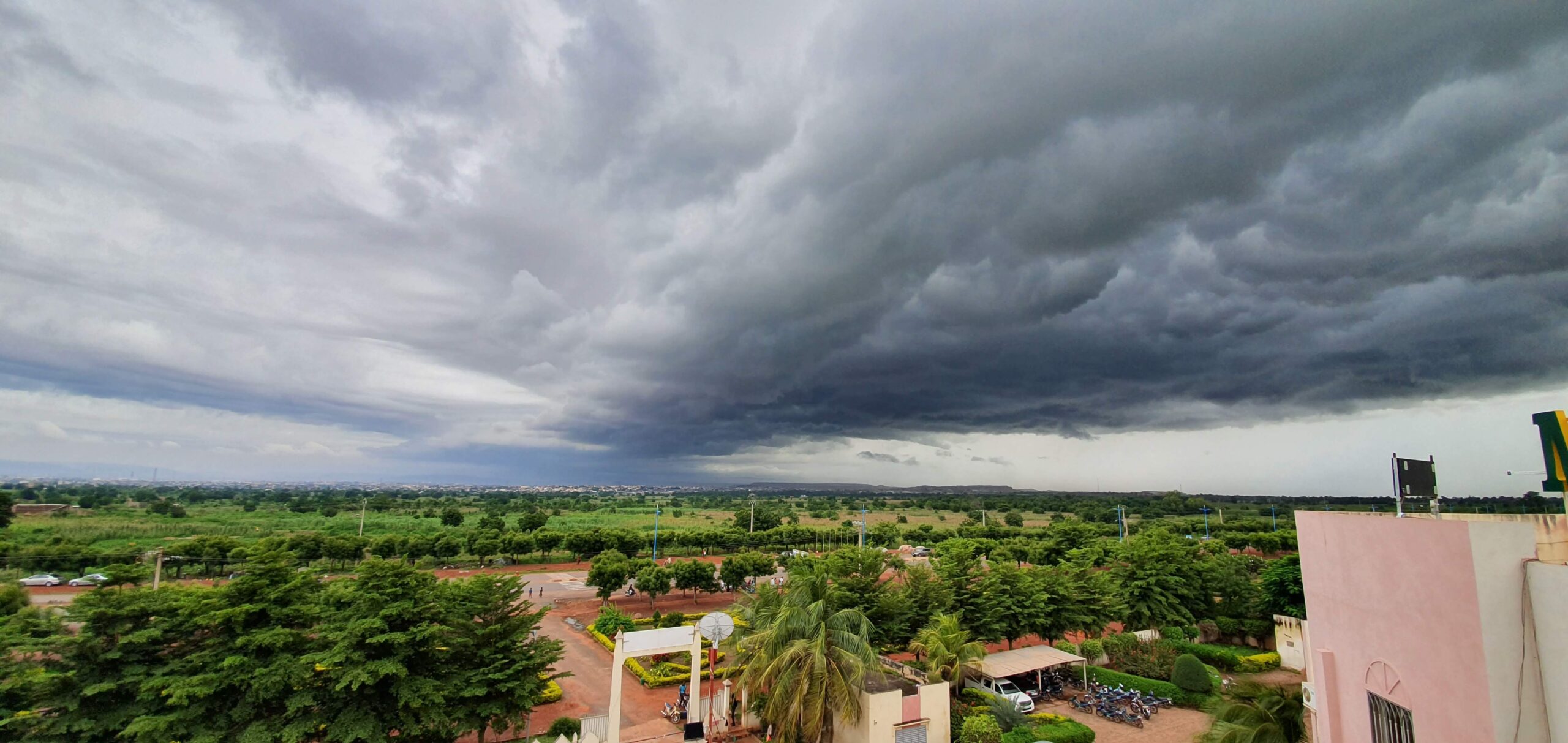
Between 2018 and 2023, I led a climate project programme in Mali that took me into some of the most operationally demanding conditions I have encountered in my career. The work involved flying aircraft directly into tropical storm systems crossing the Sahel, coordinating with the Malian military in an active conflict environment, and training farming communities whose livelihoods had been steadily eroded by decades of shifting rainfall patterns.
This is an account of what that work involved, how it was designed, and what it produced.
Understanding the Problem
Mali’s economy is closely tied to agriculture. Communities across the country depend on subsistence farming, and changes in rainfall patterns across the Sahel have had direct consequences for yields, water availability and national infrastructure. The country is divided broadly along the town of Mopti: to the north, desert; to the south, a more tropical ecosystem where most agricultural activity is concentrated.
Over the past 30 to 40 years, rainfall patterns have shifted significantly. In many cases, it is not simply that less rain is falling — it is that rain is falling in different places, bypassing the catchment areas the country depends on. This has affected not only crop yields but also the hydropower systems that generate electricity for the capital. When water levels in the dams drop, so does the power supply. Climate variability, food systems and national energy infrastructure are deeply interconnected.
My mandate was to understand what was driving the decline in agricultural yields — and then to do something about it.
Flying Into the Storm: Cloud Seeding Operations
The most operationally distinctive element of the programme was its cloud seeding work. Using a Beechcraft B200 aircraft equipped with salt flares, we flew directly into tropical storm systems moving across the Sahel. In-flight measurements tracked particle distribution and rainfall trajectories; we then seeded the front end of each storm to redirect rainfall into Mali’s catchment areas rather than allowing it to pass over the country.
The objective was not to manufacture rainfall beyond historical norms. It was to restore normalised patterns — to bring the rain back to where it had always fallen, before shifting climate conditions began redirecting it elsewhere.
The operational tempo was dictated almost entirely by weather. In a week with 15 storm systems moving through the Sahel, that means 15 concurrent operational requirements: a plane ready, a pilot authorised, a ground team positioned to take rain gauge measurements for each event. In quieter weeks, the number might drop to five. The ability to scale rapidly and maintain quality across all streams simultaneously is a non-negotiable requirement in this environment.
A Three-Phase Delivery Approach
The broader programme unfolded across three phases, each building on the last.
The first was diagnosis. This involved detailed analysis of agricultural trends across the Sahel: how and why yields had declined, how rainfall patterns had shifted, and what this meant for habitat, communities and energy systems. I used remote sensing tools including NDVI measurements to track vegetation health and biomass changes over time. This scientific foundation informed everything that followed.
The second phase was intervention — of which cloud seeding was one component. Alongside aviation operations, field teams conducted farmer training, advising communities on how to make better use of available resources, improve planting timing and strengthen local production. Conservation NGOs received technical guidance on habitat management. These activities ran in parallel, not in sequence.
The third phase was monitoring. At the close of each operational cycle, I assessed whether the work was producing measurable results: increases in agricultural yields, rising water levels in the hydropower dams, and signs of habitat recovery, including the return of certain species to areas where habitat had previously disappeared.
What a Typical Week Actually Looked Like
Operational weeks were structured but dynamic. They typically began with weather forecasting — analysing satellite imagery, radar data and synoptic conditions to determine what storm systems were likely to develop. Agricultural monitoring followed: tracking biomass and vegetation health, alongside habitat assessments to identify environmental shifts.
From there, operations moved into deployment: flight planning for pilots, ground team scheduling, and in-field activities including measurements and community engagement. The week closed with evaluation — comparing outcomes against baseline conditions to determine whether change was occurring.


What Success Looked Like
Success in Mali was not measured in outputs or reports. It was measured in what happened for people.
Farmers receiving more income because their yields had increased. Water levels rising in the hydropower dams, restoring electricity to the capital. Habitat recovering and species returning to areas where they had previously disappeared. These were the indicators that mattered — not as metrics to report, but as evidence that the work was making a tangible difference to communities and ecosystems.
Across the Sahel, despite geopolitical complexity and active conflict, the people I worked with shared the same fundamental goals: to feed their families, to feel safe, to have their children learn. Starting from that common ground is what makes the difference between interventions that sustain and those that do not.
What Delivery in Mali Actually Requires
Successful delivery in Mali is not defined by a single capability. It requires integrated scientific expertise, operational discipline, active stakeholder integration and genuine regional experience. It requires the ability to hold multiple institutional perspectives simultaneously and design projects that serve all of them. It requires comfort with constraint, and the ability to continue working through conditions that would stall less experienced organisations.
Experience in the Sahel is not a credential. It is the difference between understanding these environments from the inside and still learning what you did not know to expect.