
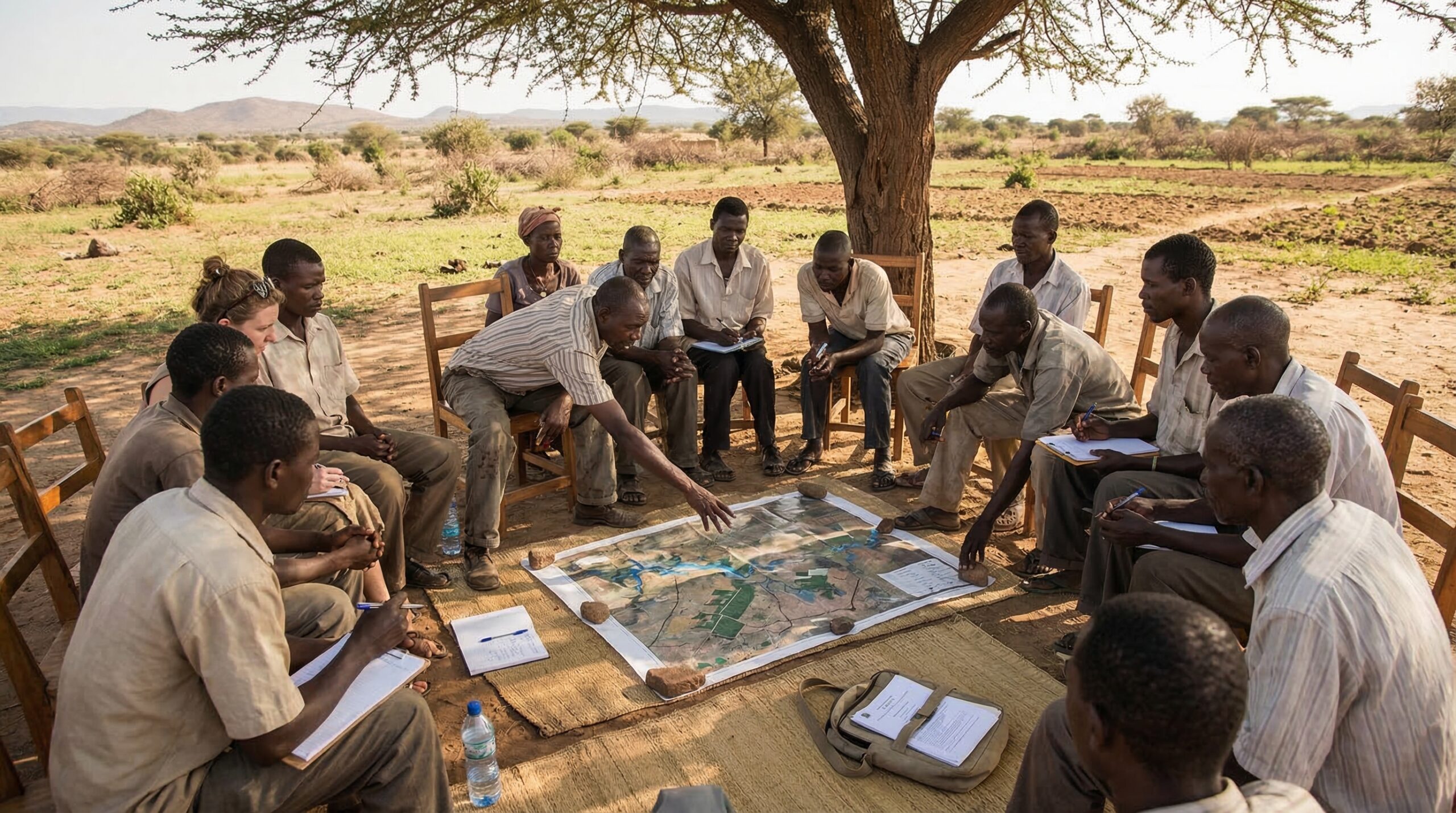
This reflection was originally written during earlier programme work in climate-vulnerable and fragile settings. Its central argument remains highly relevant: technical adaptation measures succeed only where trust, legitimacy and functional local governance already exist — or are deliberately strengthened. In current discussions on locally led adaptation and institutional sustainability, this perspective is increasingly recognised as foundational rather than complementary.
Adaptation and resilience programmes often start with what is most visible: infrastructure, technologies, early warning systems, finance, and training. These investments matter, but they are not the full story. In many climate vulnerable settings, the decisive factor is not whether an intervention is technically sound, but whether people can cooperate, resolve tensions, and act collectively under stress. Social cohesion is not a soft add-on to resilience. It is the delivery system.
Climate stress rarely arrives as a single shock. It accumulates, interacts with existing pressures, and amplifies fault lines already present in communities. Where trust is low, competition over resources intensifies, rumours travel faster than information, and local governance becomes contested. In that environment, even strong programmes can stall: targeting decisions are questioned, benefits become politicised, meetings turn performative, and uptake becomes uneven. Programmes end up managing tension instead of building resilience.
Historical conflict is a major, and often underestimated, driver of this dynamic. If past grievances are not acknowledged and addressed, they persist beneath the surface and re-emerge around project resources, leadership decisions, or perceptions of unfairness. The result is predictable: weak ownership, contested governance structures, and low sustainability once external facilitation and funding exit.
The point is not that social cohesion eliminates conflict. It is that cohesion gives communities a way to hold conflict without it becoming destructive. It turns disagreement into negotiation and grievance into process. That capacity is foundational for adaptation because adaptation is a collective action challenge. Water management, rangeland governance, early warning response, shared infrastructure maintenance, and risk-informed land use all require people to align around rules, responsibilities, and trade-offs. Without a baseline of social trust and legitimacy, those rules remain words on paper. With it, they become working institutions.
Social cohesion is also the hidden variable behind many issues teams describe as technical or behavioural. Low participation is often a safety and inclusion issue, not a mobilisation problem. Poor ownership is often a legitimacy issue, not an incentives problem. Conflict around beneficiary lists is rarely just about criteria. It is about perceived fairness, historical grievances, and mistrust in decision-making. There is a practical design implication here: treat social cohesion as an explicit pathway, not an assumption. Build it into programme sequencing, invest early in relationship building and inclusive facilitation, and design governance that people recognise as fair and representative. Use simple, observable measures of progress, such as whether diverse groups can convene, whether disputes are resolved without escalation, and whether decision-making is transparent enough to be trusted.
The core message is straightforward. Resilience is not only built through assets and information, but through relationships and legitimacy. Adaptation demands trade-offs, and trade-offs require trust. If you are designing a resilience programme, ask early: what is our deliberate plan to strengthen the relationships and local governance capacities that make collective action possible? If the answer is unclear, you may be missing the most important part of your delivery system.
At TAG International and C4 EcoSolutions, our programme experience across adaptation and mitigation contexts consistently reinforces this principle. Technical design may be robust, finance secured, and delivery systems well structured — yet long-term resilience depends on trusted local institutions and inclusive governance arrangements that communities recognise as legitimate. Our approach therefore embeds institutional strengthening, conflict-aware facilitation, and practical governance design into climate programming from the outset. By treating social cohesion as a deliberate implementation pathway, we protect investments, support sustainability beyond funding cycles and enhance measurable programme performance over time.