
Since climate change entered mainstream discourse, it has often been treated primarily as a problem of science. Policymakers and climate financiers speak in tonnes of CO₂ equivalent (tCO₂e), while armies of agronomists, hydrologists, and soil scientists have devoted themselves to developing an ever more granular understanding of how to lock carbon into the earth or prevent its release into the atmosphere. A wide landscape of technical solutions has emerged, from REDD+ and enhanced rock weathering to biomass and photovoltaics — all designed to stabilise a planet in flux.
But as the science advances, the risk grows that the human dimension of climate change is forgotten. All climate action, whether it’s about changing farming techniques, regulating grazing, adopting alternative cooking methods or planting millions of hectares of trees, ultimately depends on people changing how they live and work, and how their societies are organised. And while the science of climate change is without a doubt very difficult, experience shows that changing human behaviour is even harder.
This is why climate action flourishes where governance is strong. Looking around the world, we see hundreds of climate adaptation and mitigation projects in stable, middle-income countries such as Brazil or Malaysia. This is because, in those countries and others like them, project developers and investors can rely on governments to regulate, enforce, and incentivise; policy frameworks exist; and a relatively stable social contract allows trade-offs to be negotiated between the competing objectives of farmers and industry, of communities and mining companies; of commercial corporations and environmental protection groups. By contrast in Least Developed Countries, and particularly in fragile or conflict-affected states, institutions are often weak, legitimacy contested, and the rule of law fragile. It is in these places – often bypassed by donors and private investors due to the perceived high levels of risk – that climate action so often stalls.
A global blind spot
The Great Green Wall (GGW) in the Sahel illustrates this perfectly. Conceived in 2007 by the African Union to halt desertification across eleven countries, the initiative has made painfully slow progress. Chad, for example, claims to have planted a million trees (though the UN Convention to Combat Desertification doubts even that number’s survival). By comparison, Brazil has planted over a hundred million. The scale of ambition in the Sahel has never matched the scale of need.
It is not difficult to see why. Since 2020, the following countries along the GGW – Mauritania, Mali, Niger, Burkina Faso, Chad, Sudan and Nigeria – have experienced six successful coups and at least nine failed ones. The region is marked by insurgencies, factionalism, and the chronic absence of functioning state systems. Where law and order are contested, policy rarely survives beyond a single political cycle.
For climate investors sitting in London or New York, the calculation is brutally simple: what risk, what return? In fragile states, despite massive potential environmental and social returns, the financial numbers often don’t add up. As the UNCCD Global Land Outlook observed in 2022, “GGW projects generate low economic returns compared to the significant environmental and social benefits accrued that often have little or no market value.” And so capital continues to flow to the familiar and the stable, bypassing the places that need it most.
Climate change as a cause and a consequence of conflict
The link between instability, climate change, high investment risk and low perceived returns is not a linear one. Although it is broadly true that rich people cause climate change and poor people bear the brunt of the consequences, zoom in and the picture is far messier. Conflict is, at least in part, about competition for resources: about who controls access to land, water and other natural assets. When those resources shrink, and if there are few legitimate institutions to mediate growing competition, the result is predictable: a cycle of grievance and exclusion, and a zero-sum game of violence that majorities tend to win, reinforcing deep-seated and pre-existing narratives of minority exclusion and marginalisation. So, climate change does not just coincide with conflict dynamics; it amplifies them. By narrowing the margins of survival, it deepens historical fault-lines and feeds cycles of grievance and violent response, which in turn destroy natural ecosystems and prevent the work needed to help them recover. In short, climate change is both a cause and a consequence of fragility.
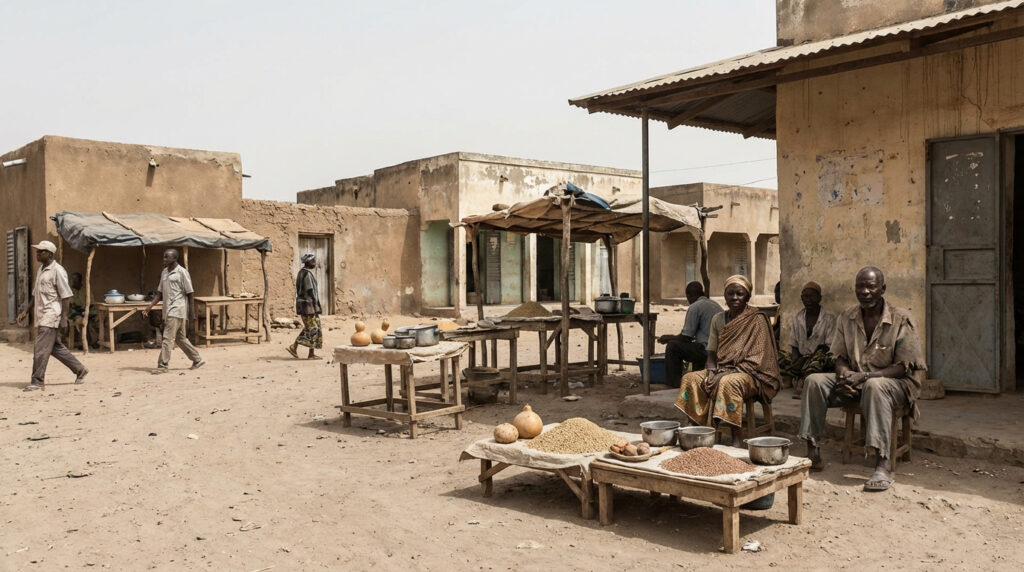
It’s depressingly easy to find examples of this interplay, and one of the clearest illustrations is found in Galmudug, a Federal Member State in central Somalia bordered by Puntland, Hirshabelle and Ethiopia. In its eight years of existence as a federal Somali state, Galmudug has experienced cycles of infighting and clan rivalry, but also glimpses of institutional emergence: a few ministries, a handful of civil servants, and a returning diaspora trying to build something resembling a state. In recent years it has enjoyed a period of relative quiet, and this has created space for the emergence of embryonic planning and administrative capabilities.
It would be a mistake, however, to envision the Galmudug State Government as a formed entity of ministries and departments. Rather, it is a loose collection of actors, chronically under-resourced and with limited reach beyond urban centres. Authority at district level rests largely in the hands of village councils, community committees, and networks of elders who mediate disputes and distribute resources.
All of these entities intersect with, and are constrained by, Somalia’s intricate web of clan and sub-clan dynamics. The legitimacy of any decision-making group, whether government or customary, depends on who you ask: if you are an adult male from the dominant local clan, or a state government official, the system tends to work for you. If you are a woman, a minority, or worse, a minority woman, it probably doesn’t.
When resources are abundant, these hierarchies are tolerable. But when scarcity set in, they became combustible. Deprived of land, grazing rights or water, disenfranchised young minorities find themselves easy recruits for militant groups, who tell them that the federal government in Mogadishu is a puppet of foreign powers bent on erasing their way of life. Exclusion from access to dwindling resources becomes a recruiting sergeant for jihad.
Layered over this flammable mix is climate change. Repeated droughts have displaced thousands into sprawling tent cities, straining the poorest host communities and pushing many over the line into malnutrition. Conflict limits movements, exacerbating overgrazing and unsustainable use of land, and eroding livelihoods further. In this interlocking series of vicious circles, scarcity fuels conflict, conflict erodes governance, weak governance amplifies climate impact, and climate impact deepens scarcity.
Leaving fragile states behind is not an option
The irony, of course, is that it is precisely in conflict-affected and unstable places like Galmudug where the potential for climate action is greatest. If the world is to have any chance of meeting the Paris target of limiting warming to below 2°C, then reclaiming the world’s largest and fastest-growing deserts, restoring its vastest and most quickly-depleting rainforests, is not a nice-to-have but a must-do. Yet if limited risk appetites leave those place behind, huge swathes of the world’s most vulnerable landscapes will be left to the ravages of deforestation, over-grazing, unsustainable farming, unlicenced mining and the further encroachment of deserts. Is it time, therefore, to consider rebalancing the risk-return equation?
From risk aversion to risk management
The route out of this vicious spiral of exclusion, grievance, population movement and scarcity, as the international community has known for decades, is climate adaptation. By adopting new agricultural methods (or in many cases reverting to ancient ones), replanting degraded land, modernising irrigation, diversifying livelihoods, and re-establishing systems of local management, Galmudug could break the cycle.
But all of this depends on investment, and in fragile states the market simply fails. As a recent SIPRI paper points out[1], climate change deepens vulnerabilities and disrupts livelihoods, yet it also opens a “strategic opportunity to generate benefits for businesses and peacebuilding.” In other words, given the right conditions the private sector, from local entrepreneurs to multinational corporations, can be an ally in peacebuilding.
But that requires de-risking investment, embedding conflict sensitivity, and treating resilience not as an act of charity but as a core business strategy. Extractive industries already operate profitably in eastern DRC, Chad, and Somalia. They do it because their returns are structured to offset the risks. If oil and mining firms can find a model that makes fragility investable, then so can climate adaptation. What might that model look like?
Building consensus for shared risk
Firstly, any effort to put in place structural financial derisking mechanisms requires greater consensus in the public sector – both among individual donor countries and multilateral organisations and funds like UNEP, GCF and GEF – that addressing climate change in conflict matters. Only with this consensus, and a willingness for public actors to absorb (or at least share) first-loss risk, will the investment community put in place the blend of political risk insurance, independent verification and benefit-sharing mechanisms needed to operate at scale in uncertainty. Blended finance models where donor capital draws in private investment are already reshaping the energy transition; they can do the same for adaptation in fragile states.
Recalibrating the upside
The other side of the risk-return equation, of course, is the question of reward. Carbon markets already assign premium values to projects with verified co-benefits like biodiversity, job creation and gender inclusion. So why not peace? Could a ‘Conflict-Reduction Carbon Credit’ do a similar job in fragile and conflict affected states? Simply put, a ton of carbon removed or avoided in Galmudug should be worth more — not less — than a ton removed or avoided in Brazil, because its social and peace dividends are far greater. A carbon project that not only reduces CO₂ but measurably reduces recruitment into armed groups, strengthens conflict resilience and drives equitable access to resources should justifiably carry a premium valuation on the carbon market, shifting the risk-return equation enough to unlock serious capital flows. Such a credit would, of course, require rigorous certification. But it would also recognise a simple truth: in fragile states, peace is the ultimate co-benefit.
A different kind of climate action
None of this means reducing climate action in stable contexts or abandoning the vital humanitarian work that keeps people alive in situations where war has plunged populations into dire need. But unless relief is coupled with systemic reform, and unless it builds the institutional scaffolding to make adaptation viable, aid merely sustains survival. If we are to meet global climate mitigation targets, programmes that harness institutional capacity-building and private-sector participation to break the cycle of scarcity and conflict are a critical part of the future development landscape.
Climate change and conflict are not parallel crises, but interlocking ones. The choice is not between climate action and peacebuilding: in fragile states, they will either succeed together or fail together.
[1] Climate-Resilient Investment in Fragile and Conflict-Affected Situations, SIPRI 2025