
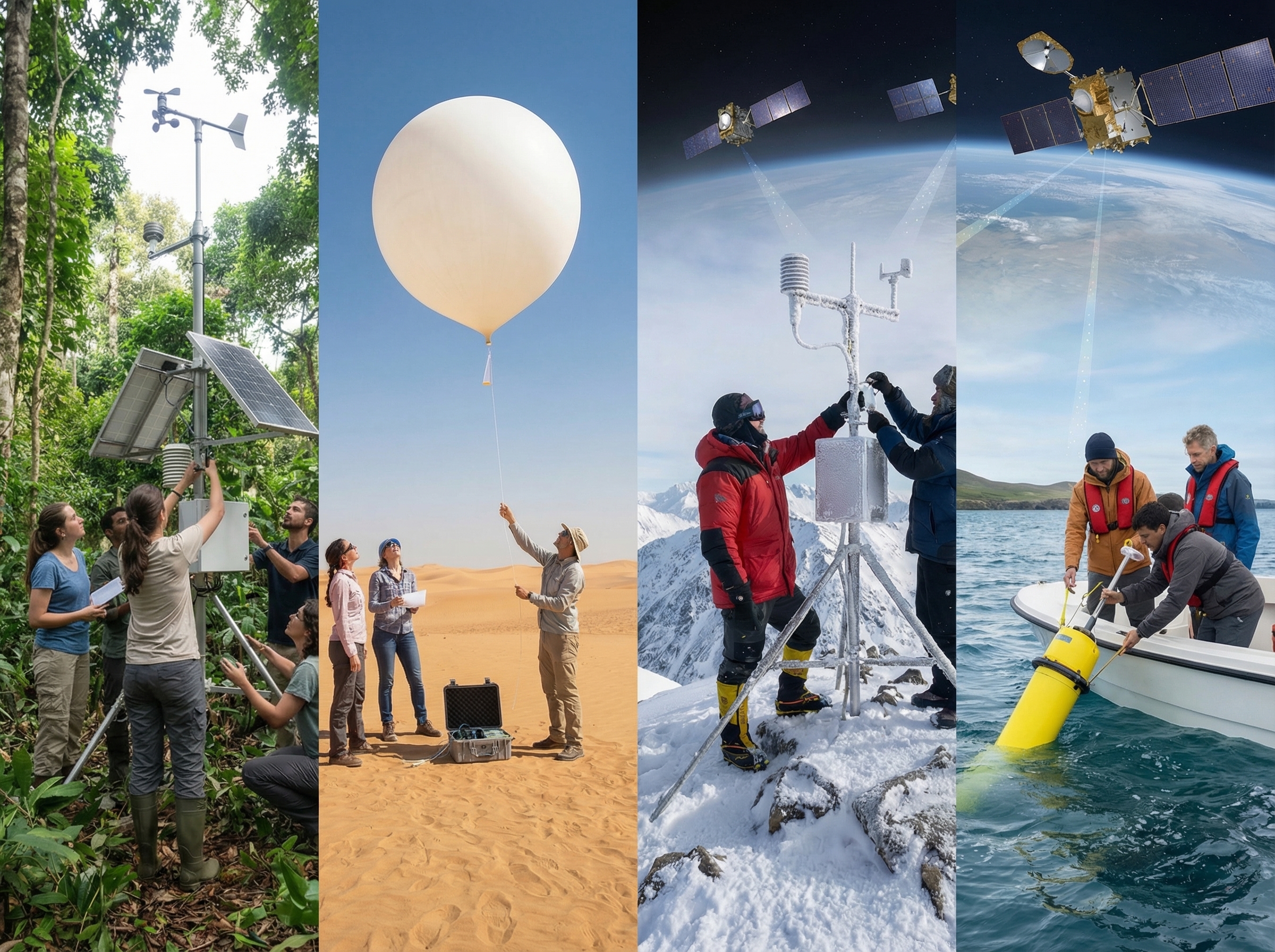
Today marks World Meteorological Day, observed annually on 23 March to commemorate the founding of the World Meteorological Organisation (WMO) in 1950. The date marks the 76th anniversary of the WMO Convention’s entry into force.
The 2026 theme — “Observing Today, Protecting Tomorrow” — centres on the global meteorological observation network: the infrastructure that collects the atmospheric, oceanic and land-surface data on which weather forecasting, early warning systems and climate adaptation planning depend. Without continuous, high-quality observation data, accurate forecasts and timely warnings are not possible.
The scale of this network is considerable. The WMO coordinates more than 16 000 surface weather stations, over 1 000 radiosonde sites, nearly 4 000 Argo robotic ocean floats, roughly 700 000 daily aircraft-based observations collected from sensors mounted on over 40 commercial airlines and more than 400 Earth observation satellites operated by over 90 space agencies. Together, these systems generate millions of measurements each day — forming the raw input for the computer models that produce weather forecasts and climate projections.

Despite the scale of this infrastructure, significant observation gaps persist. Surface station density across Africa falls well below global standards, and many stations in Least Developed Countries (LDCs) and Small Island Developing States (SIDS) are non-operational or report inconsistently. Given that weather systems move across geographical borders, missing data in one region reduces forecast model accuracy elsewhere. A data gap in the Sahel or the central Pacific, for example, weakens the reliability of forecasts in Europe or the Americas. Observation coverage is, in that sense, a shared global resource.
The economic case for closing these gaps is well established. Weather-, climate- and water-related hazards caused reported economic losses of US$4.3 trillion between 1970 and 2021. Yet just 24 hours of advance warning can reduce storm- or heatwave-related damage by up to 30%. Closing observation gaps could reduce forecast errors by 30% in Africa and 20% in the Pacific, generating an estimated US$5 billion in direct annual benefits and unlocking US$160 billion in wider economic gains across agriculture, energy, water and transport. To put that in perspective, every dollar invested in early warning systems yields approximately 30 dollars in prevented losses — one of the highest return ratios of any climate adaptation measure.
The UN’s Early Warnings for All initiative — a global effort launched to ensure that every person on Earth has access to life-saving early warning services by 2027 — depends on achieving this investment. Early warning systems comprise four components: risk knowledge, observation and monitoring, dissemination and communication, and preparedness to respond. The observation network addressed by this year’s theme underpins the second of these components and informs the first.
At C4 EcoSolutions, we integrate climate data, early warning considerations and observation system needs into our adaptation and resilience work across Africa, the Pacific and beyond. Strengthening the systems that generate reliable, high-resolution climate information is foundational to effective adaptation planning — and to protecting the communities most exposed to adverse climate change impacts and disaster risks.
Reliable observation today enables informed action tomorrow.